

Does It Even Matter?
By Andrea Prestinario

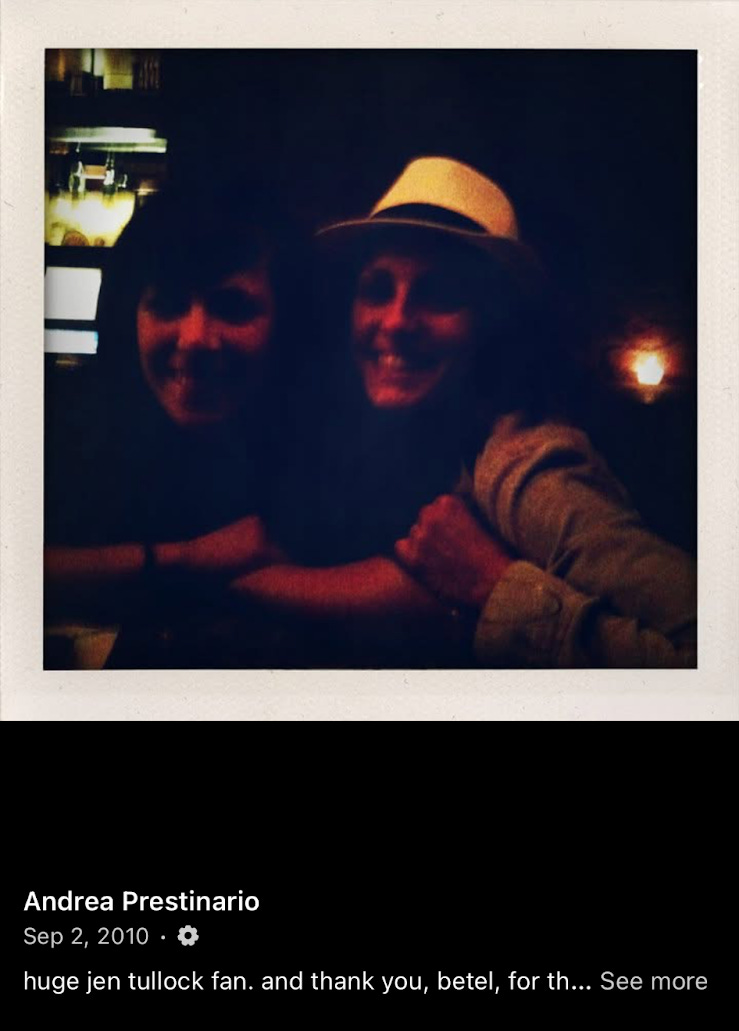
It was 2007 in Chicago when I first saw Jen Tullock perform – I remember that much. But I can’t remember the name of the solo show, what it was about, or even the theater I was seated in. What does hold tightly in the snapshots of my memory is how it made me feel: Jen’s artistry vibrated at a frequency far beyond the dingy storefront theater we inhabited, and I desperately wanted her to take me with her. We had been introduced a few years earlier when our best friends were dating, and – what is so often a fixture in the queer experience – they lovingly thought we should befriend each other because: “you know, you’re both lesbians!”
In Jen Tullock and Frank Winters’ intensely innovative and achingly beautiful queer Nothing Can Take You From The Hand of God, the protagonist Frances, a memoirist, is asked: “Now, memory is… Notoriously unreliable. I guess my question comes in two parts… The first, do you agree and the second, does it even matter?”
As her new book is being prepared for publication, Frances Reinhardt is torn between her press tour and a tour of her hometown, trying to reconcile her own memories of an abusive childhood in the Evangelical church with the version her family and friends remember. She is fighting for the right to own her narrative, amidst a multimedia assault continually trying to pull it away from her.
Structurally, the play is utterly breathtaking, seamlessly weaving together time and place with pre-recorded voiceover, live video feed, and monologues intended to be performed by a solo performer, my brilliant lesbian friend, Jen Tullock.
I am writing this essay about a popular essayist, the memoirist Frances, a character in a play about queerness and homecomings and otherness and spirituality. If the adage is “write what you know,” then in a metatheatrical way, Jen has written about what she knows by writing about Frances writing about what she knows. Her co-writer, Frank Winters, said that he and Tullock treated a lifetime of Jen’s “own experiences like a big slab of clay from which we shaped this fictional story.” I can discern some of the facts from fiction in her play: she is from Louisville, raised Evangelical, and has a brother. But, does it even matter to be able to parse out the playwright’s facts from the play’s fiction? Memoirist Sean Wilsey writes: “The true memoirist’s mission, like the novelist’s, is not so much establishing factuality as getting to the heart and truth of something.” Jen Tullock and Frank Winters persuade us to marvel at the sculpture, and not the firing of the kiln.
We all know the stories of memoirs discovered to be untrue or at least exaggerated. One example is James Frey’s self-purported memoir A Million Little Pieces, once championed by Oprah, only to be later largely discredited. This work is now classified as a semi-fictional novel. There are also memoirs altered to advance a certain narrative for gain, such as J.D. Vance’s Hillbilly Elegy, which, while some facts have been confirmed, has sparked controversy for pushing a narrative about Appalachia when its author – profiting from his characterization of the poor – didn’t even reside there.
In Nothing Can Take You… a questioning of the accuracy of Frances’ memoir is the inciting incident that triggers a litigation of her own memories. As we see her version of events laid out over the course of the play – often contradicting the memories of those around her – we ask ourselves: what is true? What is false? Who gets to control the narrative?
I am a performer, creative producer, and community builder. I created the non-profit Ring of Keys, an artist service organization amplifying queer artists in musical theater – our mission is “to queer the stage” by fostering community and visibility. My organization’s namesake is from a song in the memory musical Fun Home, an adaptation of the graphic novel by lesbian cartoonist Alison Bechdel. I have performed in three different productions of Fun Home as Alison. So I’ve spent a considerable amount of time with memory plays and queer stories. And Nothing Can Take You… deftly exists in a category of its own. The specificity, vocabulary, and imagination is wholly Jen and absolutely delights me. I felt an ache of familiarity reading this play, as if I was spending time with my friend; it embodies her quick wit, fierce intellect, and dark humor, but it also embodies familiarity with the queer experience of otherness in religious spaces.
Queer people have a history of creating “chosen family” when ostracized – like how Jen and I clung to each other two decades ago. Frances confesses to being homesick for her faith community but being unable to return home. In the way that “queering” is subverting, Frank Winters and Jen Tullock’s play invites us to queer religious spaces by reclaiming the narrative as our own; to queer the churches that have pushed out queer people, in an act of reconciliation. Does it even matter if we provide proof of suffering to validate the harm done when all memory is a lie? Alison Bechdel said of the musical adaptation of her memoir Fun Home, “even the things they made up feel true to me.”
I text Jen: “What was the name of that solo show you did in 2007?” She texts a reply. It was entitled:
…does it even matter?

Andrea Prestinario is a performer, creative producer, and community builder. NYTW, York Theatre, New York Theatre Barn, Lyric Opera, Gulfshore Playhouse, Writers’ Theatre, and more. Favorite roles include Alison in Fun Home (Studio Theatre, Baltimore Center Stage, Weston Playhouse); Maureen in RENT, Beverley in Come From Away (Paramount Theatre); Eliza in My Fair Lady (Asolo Rep) and Martha in 1776 (A.C.T) dir. Frank Galati. TV: Succession, Law & Order, and The Equalizer. Creator of non-profit Ring of Keys. Jeff Award Winner (Side Show). Recognized as “Women to Watch on Broadway 2025,” Broadway Women’s Fund.