

Learning the Language
By Adam Greenfield, Artistic Director

“I’m struck by how, in my layman’s journey of trying to understand the word ‘rheology’ and to find words worthy of describing this gorgeous new work, the language of the scientist and the language of the artist merge in a pursuit that transcends what either mode of thinking can do independently.” — Artistic Director Adam Greenfield on Rheology
In 1959, the British chemist and novelist C. P. Snow delivered a scorching lecture at the University of Cambridge, lamenting that “the intellectual life of the whole of Western society is increasingly being split into two polar groups,” artists and scientists, “between them a gulf of mutual incomprehension.” Though his accusing finger was pointed in both directions, the blame was largely placed on artists. “Once or twice I have been provoked,” he said, “and have asked the company how many of them could describe the Second Law of Thermodynamics. The response was cold: it was also negative. Yet I was asking something which is the scientific equivalent of, ‘Have you read a work of Shakespeare’s?’”
He continued, “I now believe that if I had asked an even simpler question – such as, ‘What do you mean by mass, or acceleration?’ which is the scientific equivalent of saying, ‘Can you read?’ – not more than one in ten of the highly educated would have felt that I was speaking the same language.”
I shouldn’t admit it, but the first time in this life that I confronted the word “rheology” was in an email from Misha Chowdhury’s agent, the subject of which was how his new play of this title might conflict with his availability to direct Prince Faggot. After which I didn’t even take the time to look up the word’s meaning.
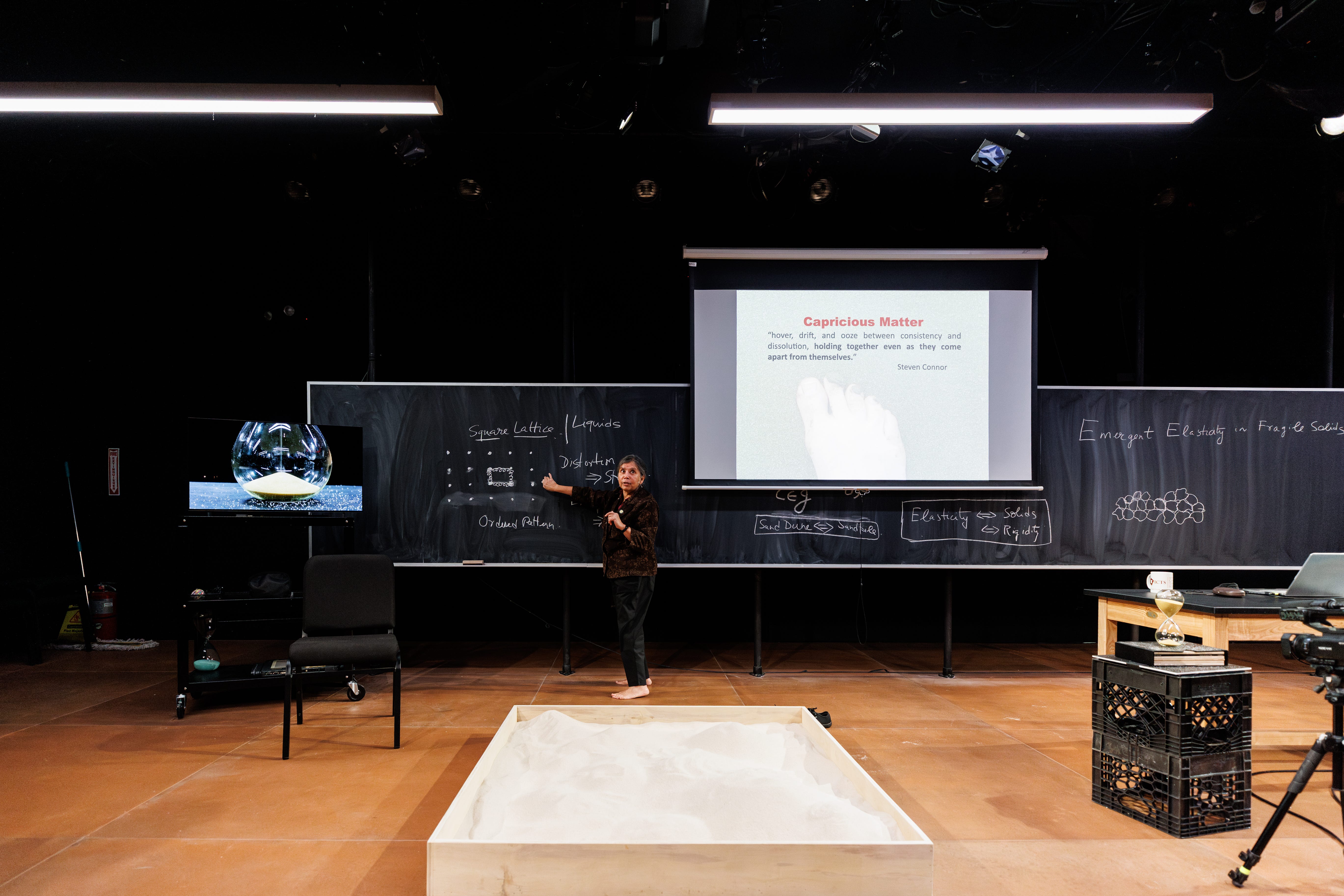
Cut to four months later, when I stumbled in a daze out of the Bushwick Starr, where Rheology premiered. Written in collaboration with his mother, physicist Bulbul Chakraborty, Rheology introduced us to the basic concepts of this branch of physics before miraculously spinning the idea into dramatic action, slyly framing the play’s contemplation of the relationship between a practicing scientist and her theater-making son. It turned an unfamiliar word into a metaphor for humanity and time that struck so deeply that I felt I’d always known its meaning.
And yet, when I rushed home to call my mother after seeing the play – like I imagine every fellow audience member at the theater that night did – I was still too illiterate to talk about “rheology.” I didn’t have any useful words.
The simplest definition I can find tells me that rheology is “the scientific study of the deformation and flow of matter, encompassing both fluid-like and solid-like behavior under applied force.” So, rheo- (flow) + ology (study of).
Looking further, I came upon some context that made my eyes pop: The word rheology was coined in 1928 by Eugene C. Bingham, a professor at Lafayette College, when he and his colleagues needed a name to unify their disparate research on mechanics – a burgeoning field of study that crossed physics, chemistry, and engineering. In founding The Society of Rheology, this cadre of scientists pioneered a new branch of science. And for this society’s motto, they chose a phrase from Ancient Greece: “παντα ρει,” pronounced “panta rhei,” translated as “everything flows.” …And thanks to one Professor Reeve at Reed College circa 1993, this is a reference I happened to know.
Panta rhei comes from the enigmatic figure Heraclitus, known as the “Weeping Philosopher” from sixth century BCE, and I fell into a bit of a rabbit hole reading his works in undergrad. “Works” may be a generous term, because his only extant piece of writing is comprised of 129 fragments of cryptic, fractured text that read like lines of the strangest poetry, like Fragment 3: “The sun is the width of a human foot.” Or Fragment 62: “Mortals are immortals and immortals are mortals, the one living the others’ death and dying the others’ life.” Or Fragment 88: “And it is the same thing in us that is quick and dead, awake and asleep, young and old; the former are shifted and become the latter, and the latter in turn are shifted and become the former.”
Pieced together these fragments form a melancholy sort of doctrine on the observable world. The term panta rhei comes from Fragment 12: “You cannot step twice into the same rivers; for fresh waters are ever flowing in upon you,” an axiom that seems to sum up this man’s core belief, that the universe is in a constant state of flux, always becoming but never being, a continuous change of matter and form. It’s a philosophy of eternal change, defying the innate human desire for stability and permanence in favor of embracing change as the only constant: always inevitable, and necessary for growth and transformation.
It would be an unforgivable disservice to say anything about what actually transpires onstage in Misha and Bulbul’s play. But I’m struck by how, in my layman’s journey of trying to understand the word “rheology” and to find words worthy of describing this gorgeous new work, the language of the scientist and the language of the artist merge in a pursuit that transcends what either mode of thinking can do independently. How beautiful that the merging of these two branches of thought is also a description of the play itself and how it was written: an enormous leap of both language and love, taken by a parent and child in the effort to understand what can’t be understood.