

On PRACTICE
By Lucas Baisch

Big Brother, jazz aesthetics, and tantrums — earlier this fall, playwright Lucas Baisch read the in-process script for Practice. Read his response below.
Naz and I sometimes text about the competitive reality television show Big Brother. We both take a perverse pleasure in lording over the program’s self-enrolled participants. They have written away months of their lives, vying for seven hundred and fifty thousand dollars, pleasantly eroding themselves in a makeshift home stamped into the corner of a Los Angeles studio. We log in. We toggle between 24-hour live feed cameras. I skip the live broadcasts and stick to the surveillance cams. Naz takes on the highly curated television episodes. We report to each other on the behaviors of our favorite players like they’re cardboard cutouts, watching them thieve each others’ secrets as ammunition for their next big chess move. A group of strangers – with the common goal of making bank – hesitate and flounder, temporarily staging some dizzy semblance of community.
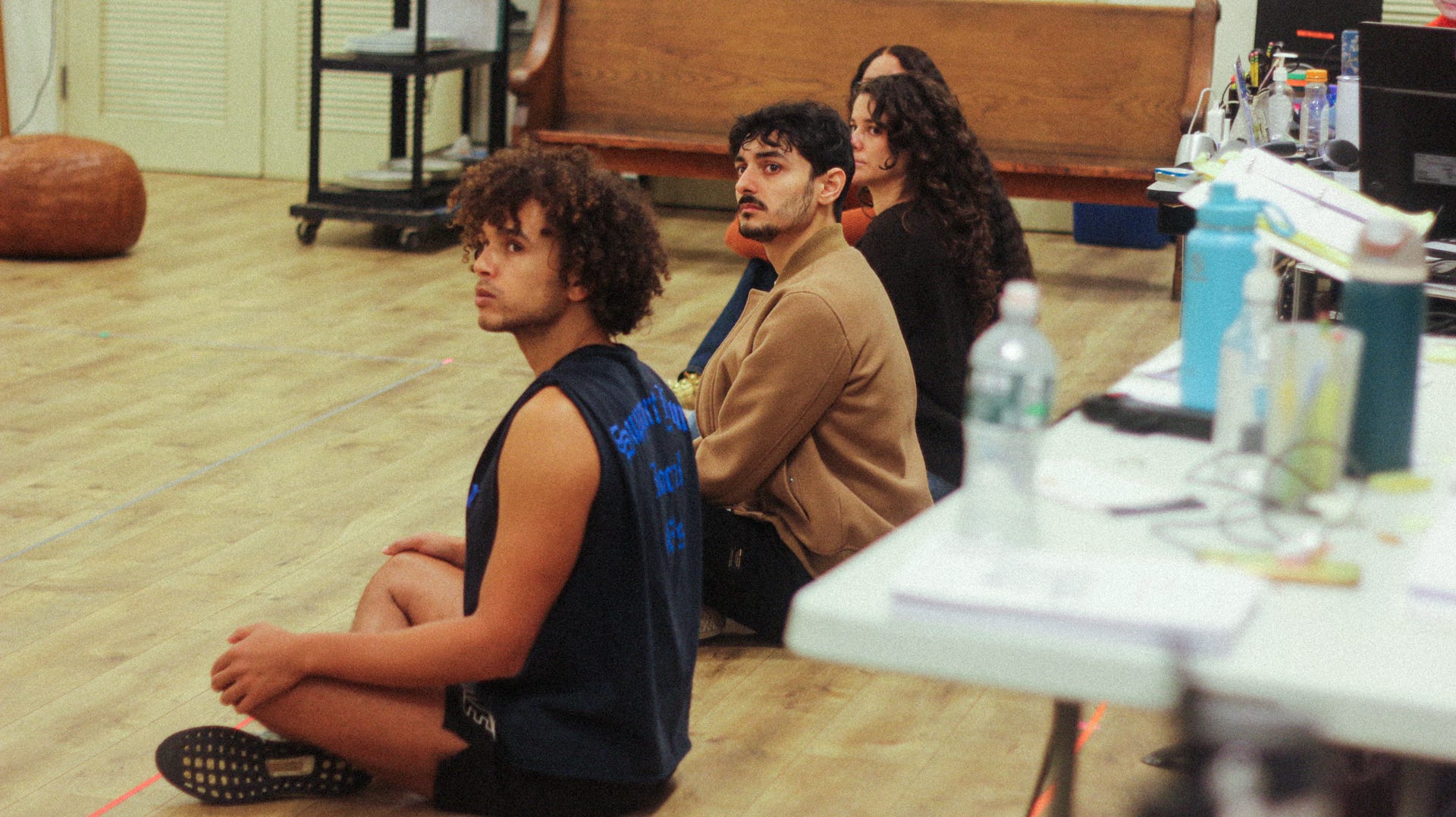
In the endnotes of Practice, Naz cites the competitive reality television show Big Brother, among a litany of other (less low-brow) references, as one inspiration for the dramaturgical engine of this play. In Practice, an experimental theatre troupe emerges, where artists have surrendered themselves to the mythic promise of genius with the common goal of a rigorous creative process. Both the play and the TV show rest on facsimiles of trust, constructed through the players’ willingness to submit to self-humiliation, haphazard community agreements, lapses in better judgment, the charms of candy, and erotic desire. A paradoxical genre arrives in the cheeky satire-non-satire, where truth is muddled to appease the in-crowd, and body mics perpetuate the poetics of voyeurism. A shadow self comes screaming down these halls. Whose flirtation will win the race?
And yet, my friend’s writing is nothing like that stupid TV show. No – Naz’s text volleys a vicious puck between clumsy players that only an expert playwright could manage. Their dialogue welts and it lures. The contours of a Rep & Rev structure (a strategy of jazz aesthetics in which a musical phrase is repeated and slightly revised) lift and politicize what Suzan-Lori Parks calls “a drama of accumulation.” The language molds, mutates, avalanches, and for Naz, revision is a spectral task. This play is hot and it won’t let you rest.
It’s funny: I met Practice after a summer of playing tourist in Berlin and Santiago’s performance venues (spoiler: relevant locations!). As voyeur, I became a willing participant amidst the allure of transnational theatre-making. I witnessed cheeks kissed, gossip bartered, smokes traded, arms gripped in embrace – and while these audiences were colliding in earnest, I was reminded of the hopscotch-dance we theatregoers stomach in New York. As in the play, “someone” mentions “someone,” and a group nods, and quick references to the latest opening or a recent project spur a waterfall of second-hand references to people that you, the listener, don’t know… and feigning a recognition of places you’ve never been before gives you some social stock, accumulating clout, positioning you, the audience, as peeping-tom to a scene, a cultural happening, a self-proclaimed temple… everyone’s spouting names and you cool your face while the mind reels… you play catch-up, laugh, sip, cough, laugh, pretend like you know – like, really know – a catalogue of talking points and procedures, or else you’re sacrificed to the drift.
I once told Naz they were sharpening an under-utilized strategy of drama: the tantrum. Vocalized or not, the figures in their plays are constantly telling on themselves. Their bratty tendencies gnash at one another, oscillating between flirtation and cruelty, pressuring the world into a state of delirium. The “tantrum” is not so much a specific outburst; it’s the fever-pitch of a world formed by desire, refusal, anticipation, and complaint. This environment is where egos are shaped and shattered. Similarly, I once told Naz I believe their work to be a queer resuscitation of Martin Esslin’s paradigmatic Theatre of the Absurd – a post-war tradition of austere, narratively castrated scenes of existential anxiety. Esslin was originally addressing an Atomic Age’s wave of impotence, a sensation quite similar to the volatile political climate we find ourselves neck-deep in. But unlike Esslin’s categorical Absurd, Practice isn’t after a logic of annihilation. The tantrum, the out-of-breath jog-in-place, the perverse spectatorship that comes with our immediate access to each other – none of it feels like self-hatred or loathing. Instead, absurd conditions present as euphoria in the face of dread – a tactic of queer bodies surviving under rigid frameworks.
Beyond the Big Brothers or the Lord of the Flies or The Twilight Zone’s “The Monsters are Due on Maple Street” or the Stanford Prison Experiments of the world, Naz’s play moves past the allegory of the social experiment. This work is a sweet, metallic rush. It is the aftermath of TikTok brainrot Bacchanalia. It is stammering awake from a constant nightmare. It’s being told there’s more to life than being useful. Practice feels like flipping the husk of my skin inside out. And then I’ve glued eyeballs to the back of my head in hopes that I’ll catch someone watching me, someone paying attention, someone’s affirmation that I exist. And I’ve been told that I asked for it. And I’ve been told that I love it. And I think I do. I think I always have.

Lucas Baisch is a playwright from San Francisco. He’s the author of 404 Not Found (53rd State Press), Dry Swallow (Bloomsbury), and On the Y-Axis (Theater Magazine). He’s a recipient of the Steinberg Playwright Award, the Princess Grace Award, a Jerome Fellowship, and the Chesley/Bumbalo Award. He writes on excess, scale, transgressive literatures, and the poetics of decomposition. He holds an MFA from Brown University and is currently pursuing a PhD at Stanford.