

The time it needs to take
By Lila Neugebauer

On showing up and sharing stories: Read Tony-nominated director Lila Neugebauer on community and the movement of time in The Dinosaurs, then grab your own tickets.
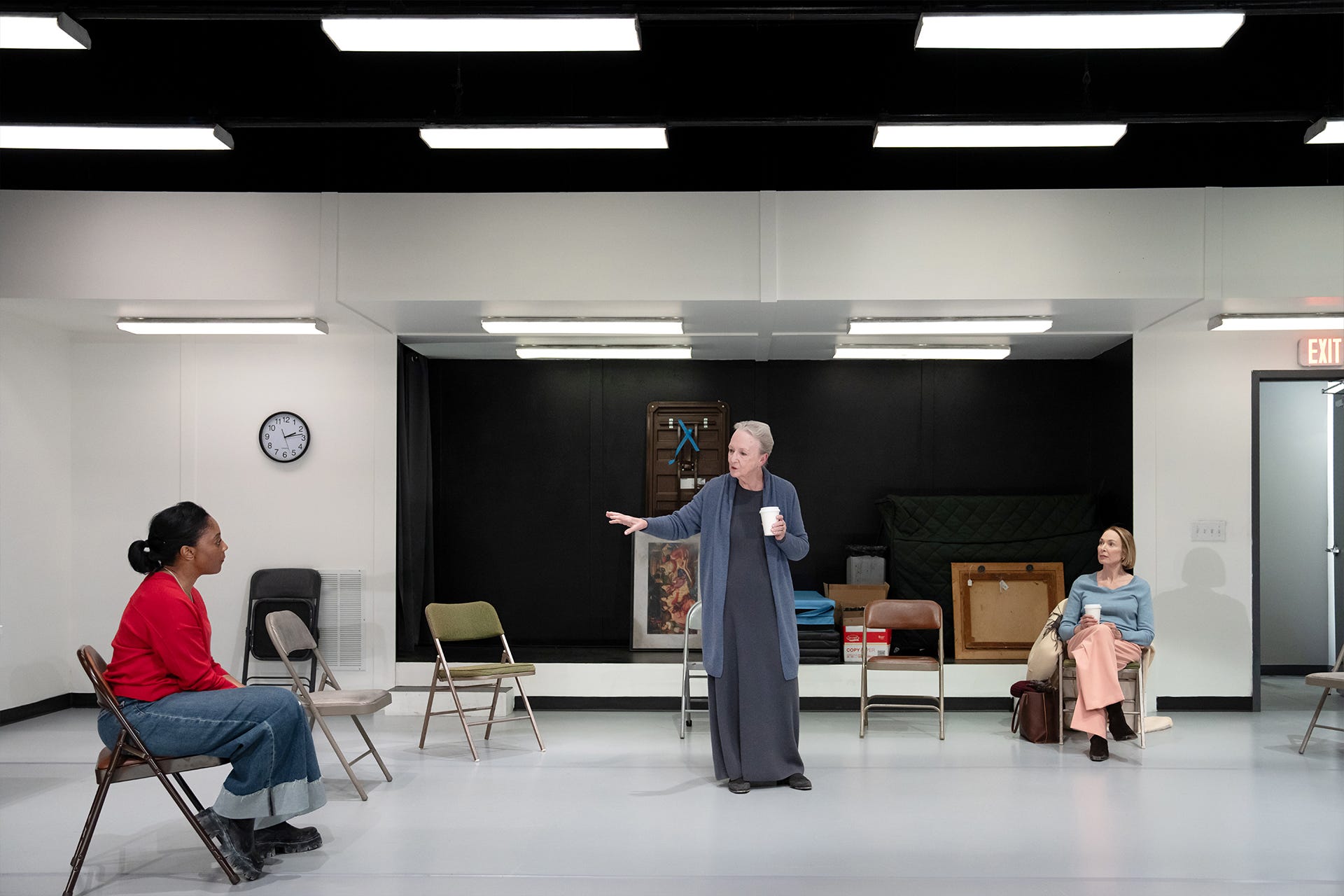
In Jacob Perkins’ The Dinosaurs, a group of women assembles in an unidentified multi-purpose room for a recovery meeting. When the meeting officially begins, we learn they’re called Saturday Survivors and that their “primary purpose is to stay sober and help other alcoholics to achieve sobriety.” But by this point, the meeting has already begun. And the meeting begins again (and again) more times than I can definitively count throughout this gently time-bending play.
The Dinosaurs transpires for roughly the amount of time it takes to set up the room for the meeting, have the meeting, and break down the room after the meeting. But within these 75 minutes, more than 13 years go by. How many years exactly? I don’t know, and I think that’s right where Jacob Perkins and director Les Waters want me. For one alcoholic, several decades collapse into 60 seconds of stage time. For another, an attempt to begin the recovery journey is traversed in fragments that expand kaleidoscopically into a whole that profoundly exceeds the sum of its onstage parts. A three-minute meditation becomes a portal to another day in this room, another meeting, another encounter: seen from one perspective, it might be a passing exchange — from another, it might just be the conversation that saved her life.
These disruptions in time are not telegraphed through loud theatrical gestures. Les and his team of sensitive, astute designers trust the dynamics of the play’s language, and the calibration of these exquisite actors’ performances, to tell us what we need to know about time.
“Am I too late?” a woman asks towards the play’s end. She’s arrived after the meeting has ended, and she’s closer to the end of her life than the beginning. Is she too late to begin the journey? “You’re right on time,” she’s reassured. “It takes the time it needs to take,” we’re told throughout the evening. The topic of this week’s meeting is: Coming Back.
Each night we spend at the theater, we live through time according to the rules of the play-world in front of us. The play invents time. Does it move slowly or quickly? How is its passage marked? Is time linear? Cyclical? Does it stand still? In The Dinosaurs, the meeting’s appointed timekeeper ensures that sharing is kept to its allotted increment. But the clock on the wall of the multi-purpose room has stopped. Jacob expands and contracts time in equal measure, coaxing us into the ritual return that constitutes membership here. You, too, have been showing up here, all these years. You, too, have just arrived and don’t know how to begin. You, too, are afraid you might be too late. You, too, are right on time, so long as you come back.
I’m not in recovery, and I’ve heard enough about recovery from loved ones living it to know I don’t have anything smart to say about it. But Jacob, your play encourages a feeling I’ve had for some time: that you don’t have to believe in a received notion of God to have a higher power. And if you believe in the power of things you can’t see or buy or quantify — things like compassion, service to others, the capacity of a temporary, chosen community to help you heal — then you might have plenty of higher powers to choose from.
By reminding me that in tens of thousands of rooms around the world, people are getting together with strangers for an hour at a time, telling each other stories to try to stay alive and to help others do the same — not for money, status, or any material gain — your play has made me feel a little less pessimistic about the present business of being a person, or at least about what’s possible when we’re guided by our better natures.
What might happen if any of us, in recovery or not, woke up and admitted our own powerlessness in the face of something we had no idea how to change but knew we had to? What if we asked for help? And what if, in the face of setbacks, shame, our own fear and limitations, we just kept coming back to try?

Lila Neugebauer is a stage and screen director based in Brooklyn, NY. Her theater work has been seen on Broadway, off, and regionally, and her television work can be seen on Netflix, HBO Max, Apple TV+, and Hulu. She made her feature directorial debut with Causeway, starring Jennifer Lawrence and Brian Tyree Henry. Recipient of the Obie, Drama Desk, and Princess Grace Statute Awards; Tony nomination for her direction of Branden Jacobs-Jenkins’ Appropriate.