

Three Silly Sailors
By Adam Greenfield, Artistic Director

“Milo Cramer’s writing is extraordinary – and I mean that in the literal sense of the word, that their plays live beyond the ordinary, outside of anything we know.” — Artistic Director Adam Greenfield on No Singing in the Navy
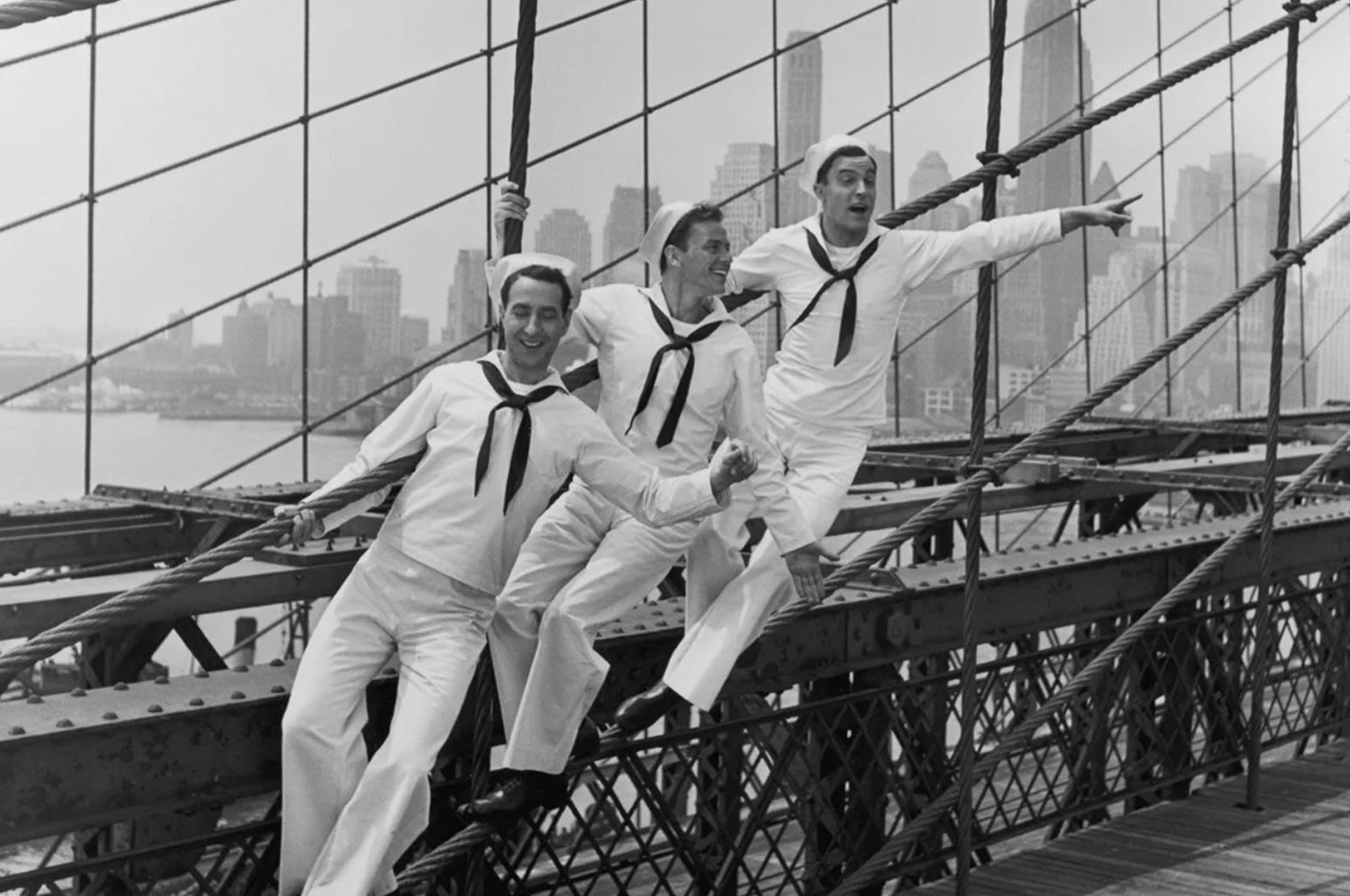
It’s largely believed that The American Musical is our country’s unique contribution to world theater history. Though it borrowed from other nations’ traditions – the British music hall, the French opera bouffe, the Italian commedia, the German operetta – its synthesis of forms and styles emerged in the 19th century as a distinctly American phenomenon: the creation of a new artistic genre born from the so-called melting pot.
The “Golden Age” of musicals is an era that fell roughly between 1943 and 1963, riding a wave of post-war American optimism and prosperity. Returning from the war victorious, the U.S. entered a hopeful period that saw a hike in industrial productivity, creating some 17 million jobs and doubling corporate profits. The American Dream of upward mobility was becoming more attainable – to some, anyway – as Americans began to form families and have children in unprecedented numbers, embracing consumerism as the nation’s dominant ideology.
That particular American brand of bootstraps optimism is reflected in musicals like Oklahoma! (1943), Annie Get Your Gun (1946), and The Music Man (1957) – musicals I was raised on, each of which is propelled by a spirit of American grit, reinvention, opportunity, ambition, self-improvement; and each of which is a glorious, ridiculous – if problematic – delight.
In terms of musical theater catnip, though, can anything top the weird sub-genre of musicals about sailors on leave? Musicals like Anchors Aweigh (1945), in which sailors on leave chase fame and romance against the backdrop of Hollywood glamor (and in which Gene Kelly dances with an animated mouse)? Or On the Town (1944), the quintessential Golden Age musical about three sailors on a 24-hour leave in New York City, who sing and dance up a wonderland of wild hot fun before shipping off to war and certain victory?
And yet, writing about the Golden Age in the year 2026 carries a sour taste. It’s like trying to conjure an America that’s locked in a hope chest in someone’s grandparents’ dusty attic, or which is floating through distant outer space trapped in glass, like the Kryptonian villain “General Zod” and his goons at the end of Superman II. It’s unsettling even to imagine that era of hope, prosperity, and optimism, especially since, to state the obvious, that America didn’t exist.
In 1944, the year On the Town premiered onstage, America was awakening to the scale of Holocaust murders, while over 100,000 Japanese Americans were living in U.S. concentration camps. Jackie Robinson, then a lieutenant in the U.S. army, was court-martialed after he refused to move to the back of an army bus. “Blue tickets” were issued to homosexuals in the military, discharging them from service without honors and denying them the benefits of the G.I. Bill. The first “equal pay for equal work” legislation, seeking to end discrimination in the work place on the basis of sex, was shot down in Congress. …Etcetera, etcetera, obviously.
And yet that mythical post-war setting continues to loom over our lives like a sea of red baseball caps screaming to Make America Great Again, harkening to a time of peace and prosperity that never was – at least, not for most of the nation.
The most iconic post-war image is a photo taken by Alfred Eisenstaedt on V-Day in Times Square. It features a victorious soldier deep-kissing an anonymous woman in celebration, evoking the unbridled joy of the moment. Years later, we learned that woman’s name: Greta Zimmer Friedman. She was an immigrant Holocaust survivor who’d lost both parents in a Nazi concentration camp. When interviewed, she clarified that she had mixed feelings about being grabbed and kissed forcefully by a stranger.
Personally, I was indoctrinated with the idea of this fake place from my earliest education, only to learn gradually as I left childhood to recognize the lie; to see the desperation in it; and to laugh at it, enjoying it only between quotes. And yet, it’s hard to shake a myth. There will always be some tiny part of me locked in that hope chest, or spinning with General Zod through space, that equates America with that idealized world of confidence, heart, and swagger.
Milo Cramer’s writing is extraordinary – and I mean that in the literal sense of the word, that their plays live beyond the ordinary, outside of anything we know. Their work approaches the world with a brand of wonder and awe that’s at the same time savvy and deeply skeptical. Any innocence or sweetness their characters might still possess seems to exist only in spite of an unknowable system that’s indifferent to such things. While no one could have predicted that Milo’s newest play would riff on the wide-eyed patriotism of mid-century American musicals, it seems inevitable somehow.
I picture three sailors fake-running toward center stage, hands on their sailor caps to keep them from falling off; they stop, planting their feet, arms extended, and sing, New York, New York! It’s a wonderful town! …Meanwhile, in a fun-house alternate reality within this, I picture present-day Milo walking through the streets of New York with their own song: one that’s dizzy with doubt, skepticism, ecstasy, wonder, and despair. And that sweet tune, I think, is No Singing in the Navy.