

Two Truths
By Ife Olujobi

Today, we’re excited to share a Production Perspective by playwright Ife Olujobi on Practice and “truth” in performance. Read their response below.
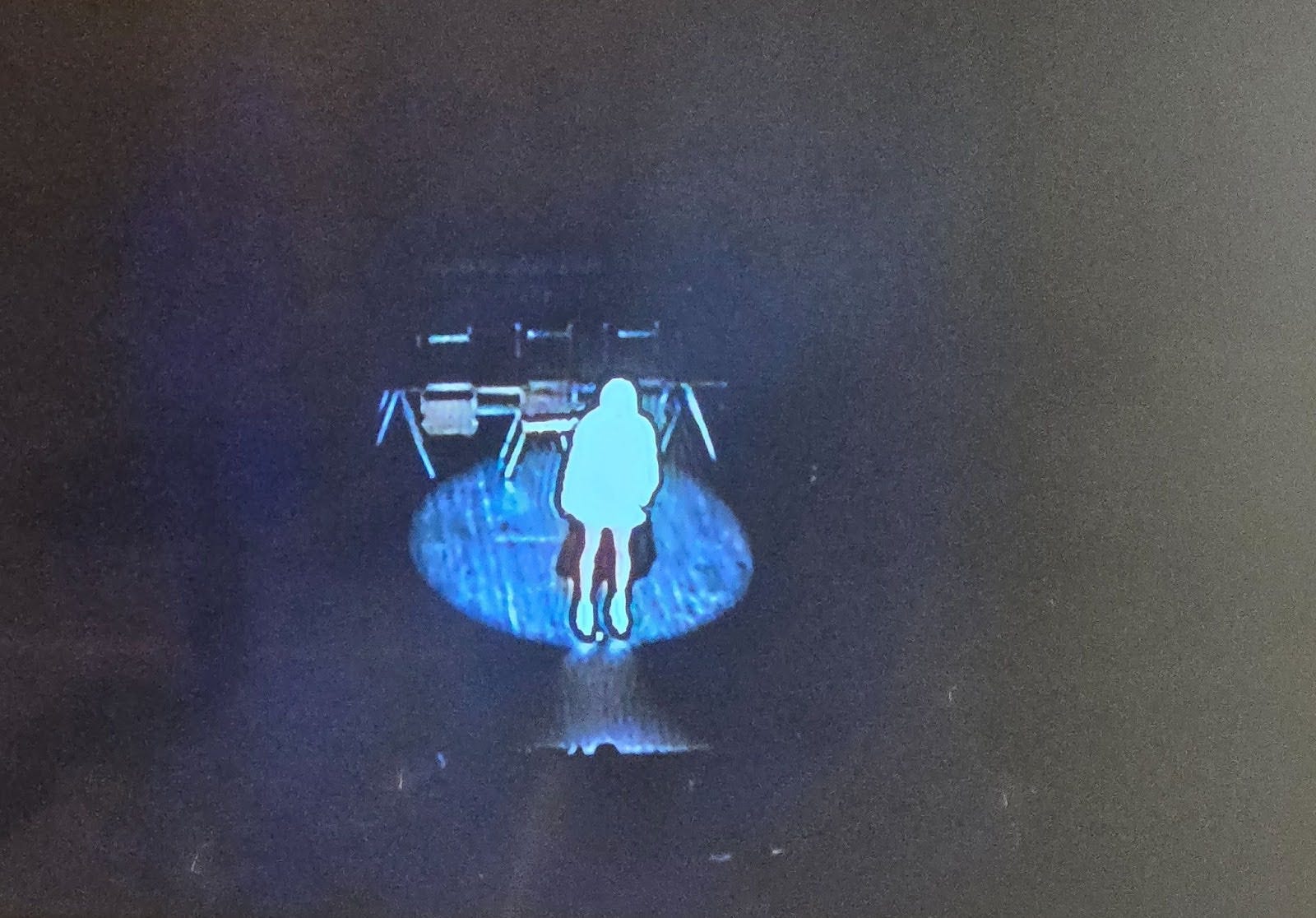
I must admit I arrived at the theater 10 minutes late (at 7:40pm to be exact!) on the night I saw Practice. Waiting for the late-seating cue, I stood as close to the lobby’s video monitor as possible, wondering why the image on the screen before me was so full of static, blown out and fuzzy, like a rug.
I want to bend over and become a rug.
Im gonna go drink now, and maybe ill end up on the floor.
One of the performers within the show delivers an audition monologue I had heard Naz recite on The Poetry Project’s livestream the night before. I can’t tell which performer, though, because on the screen they all look like glowing white blobs with arms and legs — no race, no gender, no age, no class markers, no face. After the play was over I thought that this must be how Asa — the director character played by a fiendishly calculating Ronald Peet — saw their performers: not as individuals or even fellow human beings, but as bright blank slates, mental projections ready to be projected upon, molded, filled in. I wonder how it feels to enter a room unsure of who you are and then be given an identity by strangers over the course of several weeks. But then, I’ve made a play before.
I think about how both communism and fascism require a suppressing of the self, an ego-death yielding to the collective will. But communists don’t have hierarchies, and this rehearsal room does. Evaluated, supposedly, on the shared criteria of rigor, vulnerability, honesty, respect, and curiosity, I watched the production’s actors-playing-performers moved to tears by the sheer power of their memories and grief, sharing their traumas and insecurities freely before being programmed to expose them on demand. Meanwhile, Asa, with the help of their brooding romantic partner Walton (Mark Junek) and overeager dramaturg Danny (Alex Wyse), hangs large microphones over the performers’ heads, capturing their every utterance so that there is no air in the room, no single intake of breath that won’t be fashioned against them on the psychological battlefield of professional theatermaking. A battlefield, or is it a prison? The strict training, mechanized meal times, systematized demerits and humiliations gesture towards conditions for punishment and control rather than for expression, and yet art is being made. They lock eyes and jump together. Asa plots their next act of sabotage. An actor cries, the audience laughs. Is a performance of performance always satire? Or is it satire because we laugh?
In Practice, it seems, there is a thin line between humor and cruelty. Watching Asa interrogate the company about jellybeans is funny, until Mel (Karina Curet) starts to hyperventilate under the silent gaze of her peers. When we finally see the performance Asa and the company have been devising, there is comedy in the exaggerated impersonations the company does of each other, even as they reduce their ethnic backgrounds and deepest shames to vicious playground insults under the guise of experimental art. But it’s okay because they all consented, says Asa, as Asa takes up residence in the bodies and minds of their company. The company would do anything for Asa.
my mental breakdowns became my craft, and i couldnt tell the difference between the two.
Asa makes a performance of their mental illness. We clap. “If artmaking is a sickness, can it be cured through collective purging?” I scribble in my journal, sitting in the audience, watching talented actors play performers who have agreed to a kind of psychosis as a way to process the traumas that have been extracted from them for our entertainment, or to secure the next grant for their malevolent leader. And what would even be a cure? For the company, it’s accepting Asa’s mantra that it’s okay to be useless: no matter the depth and frequency of your past sins or the magnitude of your regret, you can find salvation if you only accept that you’re useless, and that’s okay. Every problem has the same answer. We watch as seven vibrant young people with unique histories and personalities are flattened, spiritually and psychologically, through the pursuit of absolution, of catharsis, offered to them by someone who is still very much lost. This is not unlike the way a person enters a theater and becomes an anonymous audience member, expecting the almighty artist to reveal something to them — some insight about the state of the world, a theory of human nature, a fundamental truth about themselves. To reject this expectation may be the most daring coup Naz effects with Practice.
What is the value of “truth” in performance, anyway? There is the truth of the tragedy Tristan (Omar Shafiuzzaman) shares with the group about the death of his cousin. There is truth in Angelique’s (a magnetic Maya Margarita) critique of Asa, as Asa plays a recording of it back to her in an attempt to embarrass her and assert power over the group. There is the truth that no one is “forcing” the company to endure Asa’s treatment. When Asa finally tells their “truth” — speaking through the mouths of the company-as-cult, dressed in what look like designer skin bags, wearing each other’s eyes, cosplaying humanness — almost everything they’ve told us before that performance begins becomes a lie.
so this performance is more of a documentary
like a hybrid doc
like its real text that these performers actually said but like rewritten by me
some of its fake too so youll have to guess
There are other truths – emotional truths – that feel true (not in a “fake news” kind of way, but in a way where you only learn the truth of a thing when you feel it). These are the kinds of truths we exchange in the theater. Playwrights and directors are always trying to get at these kinds of truths in their work. Practice wants us to face some violent truths about how and why we make theater at all. With a scientist’s tools of observation and hypothesis, Naz dissects Asa’s hegemony over the production process until what those of us who work in the theater see as routine becomes strange, manufactured – not an inevitability, but a choice we’re all making all the time to bend until reality breaks. Practice challenges fictions masquerading as truths to expose truths through constructed fictions. In other words, this performance is a documentary.
Another documentary that came to mind as I watched Practice unfold was Liane Brandon’s 1972 short Betty Tells Her Story. In it, a former schoolteacher recounts her search for and subsequent loss of a pretty dress to wear to the Governor’s Ball. We don’t know why or under what circumstances she’s been asked to tell her story, but she tells it twice. The first time she speaks to the camera as if she’s catching up with a friend over coffee, perhaps performing what she thinks an imagined audience will find most entertaining. She revels in the coincidences and colorful details, framing her sadness over the loss of the dress — and the vision of herself in it — as part of some lesson learned. The second time she tells it her voice is halting, she looks down at her fidgeting hands, there’s less joy and more introspection, confusion, lamentation over the whole episode. Who is she speaking to now? Who is she now? Which version is her truth? All we know is that, sometime after the first telling, “the filmmaker asked Betty to tell her story again.”
Ah, there it is.

Ife Olujobi is a Brooklyn-based Nigerian American playwright, editor, and filmmaker whose work aims to fuck around and find out. They’re the recipient of a Steinberg Playwright Award, a Helen Merrill Award, a special commendation from the Susan Smith Blackburn Prize, an Advocacy Award from the Dramatists Guild for her organizing work in support of playwrights, and an Obie Award for her play Jordans.